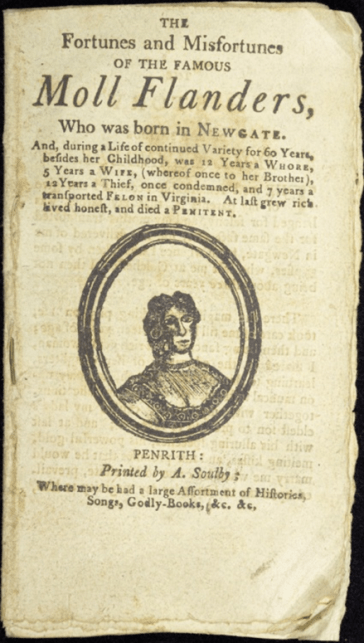
Moll Flanders is essentially a prisoner from birth. Thus, it makes sense that Defoe conceals her true identity. It fits the narrative of having her identity stripped like a prisoner. From the very moment she was born, she was an ‘offspring of debauchery and vice’ (preface, 2), her life was set up to be miserable and unfortunate. Being born in a prison perhaps created a bad omen for the rest of her life. In the preface of the novel, the author chooses to not disclose the reader with Moll Flanders real name. This sets the reader to view Flanders as a mysterious person, and it perhaps shows that Moll does not trust the reader knowing her true identity due to the fear of receiving judgement for the vices and crimes she commits. She is ultimately anonymous like the inmates who have nothing but a number to identify them.
Defoe states in the preface that he would not alter anything when telling Flanders’ story; ‘no immodest turns in the new dressing up of this story; no, not to the worst parts of her expressions. To this purpose, some of the vicious part of her life, which could not be modestly told, is quite left out’ (preface, 2). Here Defoe could be suggesting that his work is genuine and authentic and that he is simply highlighting the misfortunes that moll undergoes This is perhaps a warning to readers that the story may highlight dark and grim themes.
However, if you think about it, Defoe being a male author who is essentially writing a fictional novel from a female’s account, it makes you question? He mentions at the beginning of the preface; ‘It is true that the original of this story is put into new words, and the style of the famous lady we here speak of is a little altered’ (preface, 2) although he states, we as readers do not know what he has altered so it is quite suspicious how he decided to point this out.
Furthermore, Defoe states himself that the novel is not written entirely from Flanders’ perspective but rather ‘her husband’s life, being written by a third hand’ (preface, 5). Once again, this suggests this account may not be as trustworthy as we are not sure how altered the story is from the husband’s perspective. However, Defoe seems to justify this by writing ‘indeed, that this history is carried on quite to the end of the life of this famous Moll Flanders, as she calls herself, for nobody can write their own life to the full end of it, unless they can write it after they are dead.’ (preface, 5) This highlights how contradictory the story could be as it is solely based on the perspective of men.
Bibliography
Defoe, Daniel. (1993) Moll Flanders. Wordsworth Editions, 1993.
 voices from the inside